
Why is Drawing Good for You?
Anchoring Memory Beyond Ready-made Thoughts
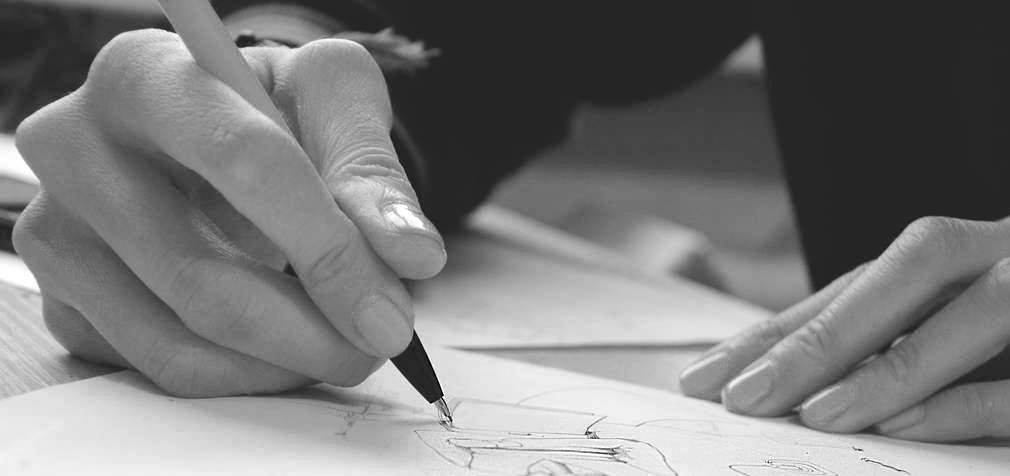
How long ago did you write or draw using a pencil? Are you among those who switched from handwriting or drawing to typing, touch screens and styluses?
Traditional drawing and “cursive” writing are not among the favourites any longer. Those activities are not in school curriculum in many countries around the world. Using photos and editing is less time-consuming and seems more efficient. We combine dozens of images and create collages that tell a ‘story’ with available software without ‘wasting’ too much time. Moreover, print is clearer and easier to read than the script and is also easier to write. When we are reading, few of us wonder whether a text was written by hand or word-processed, and we are told that what matters is the message the text conveys.
Gestures anchor memory
So, we cut and paste, and undo.
However, cognitive neurologists would not agree that the way how we write and draw is irrelevant. (Footnote: Cisek & Kalaska, 2005, Neural Correlates of Reaching Decisions in Dorsal Premotor Cortex: Specification of Multiple Direction Choices and Final Selection of Action, Neuron; Roberts et al., 2008, Movement Imagery Ability: Development and Assessment of a Revised Version of the Vividness of Movement Imagery Questionnaire, Journal of Sport & Exercise Psychology) Drawing and writing by hand are closely related to “body memory” (Footnote: Cohn, N., 2012, Explaining ‘I Can’t Draw’: Parallels between the Structure and Development of Language and Drawing, Human Development) This is why those activities are often used to improve the coordination, balance and cognition of individuals who suffered a stroke or similar brain injuries (Footnote: Chamberlain, et al., 2014, Drawing on the right side of the brain: A voxel-based morphometry analysis of observational drawing. NeuroImage) These patients easier remember the alphabet after tracing the letters with their finger. The gesture anchors and restores the memory. Significant progress is present in other disorders when eye and hand coordination activities are applied and involve no tracing of existing lines but a purposeful movement.
Just as perception is not a passive recording of stimuli, cognition is not about rendering an accurate representation of reality. (Footnote: Neisser, U., 1967, Cognitive Psychology. Englewood Cliffs, NJ: Prentice Hall; Singer, W., 2013, Cortical dynamics revisited. Trends in Cognitive Science ) Perception is the active process of comparison between sensory inputs and predictions based on global configuration and context, (Footnote: Bar, M., 2004, Visual objects in context.Nature Reviews Neuroscience; Murray, Schrater, & Kersten, 2004, Perceptual grouping and the interactions between visual cortical areas. Neural Networks; Oliva & Torralba, 2007,The role of context in object recognition. Trends in Cognitive Sciences. ) knowledge and experience, (Footnote: Clark, A., 2013,Whatever next? Predictive brains, situated agents, and the future of cognitive science. Behavioral and Brain Sciences; Engel, et al. 2013, Where’s the action? The pragmatic turn in cognitive science. Trends in Cognitive Sciences. ) and expectations. (Footnote: Egner, et al., 2010,Expectation and surprise determine neural population responses in the ventral visual stream. The Journal of Neuroscience. ) Therefore, cognition is forming meaningful inferences of the world by interacting with it based on what we already know and expect.
Writing and drawing with pens and pencils involve very different cognitive processes than typing or collage arrangement. Complex various skills are involved in drawing – finger control - fine motor skills, and if drawing on a larger surface with involvement of elbow and shoulder - gross motor skills, together with planning, organisation and execution of movement, feel of paper, directing of pressure and eye-hand coordination, the balance of visual form, emotion processing, and attention. People take years to master these skills. Operating a keyboard is not the same, often all we have to do is press the key or undo our previous actions. Imagine the ways in which that simple action undo can affect your thinking alone.
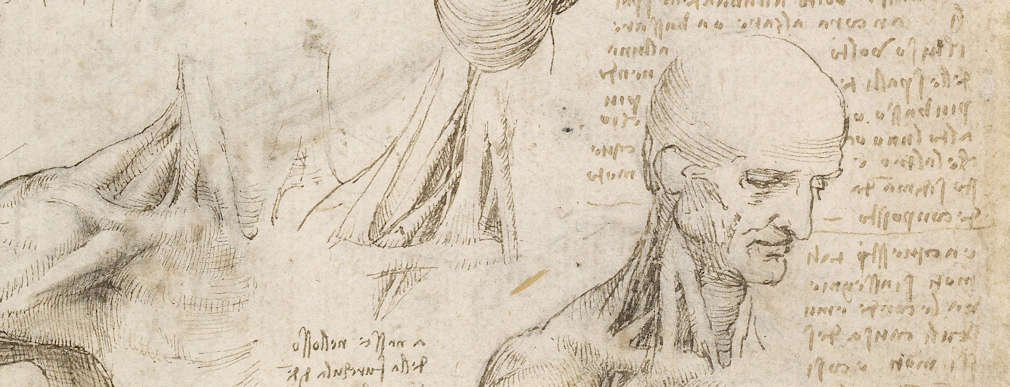
Drawing or handwriting is the result of a singular movement of the body and conscious thought which cannot be erased or edited, so mistakes are visible. This is why through centuries many schools of fine art encouraged their art students to leave their mistakes visible. The never-lost charm of Leonardo’s sketches (fig2.) lies in the visibility of the drawing process, where every subtle line is like a thought searching for the form - none is lost nor forgotten.
Then, we have a challenge to explore the new possibilities, to refine the move. When focusing on searching rather then finding our brains work harder, which brings us to brain plasticity, also known as neuroplasticity – a term that refers to the brain's ability to change and adapt as a result of the experience. It is the ability of neural networks in the brain to change through growth and reorganisation. These changes are crucial in rehabilitation (e.g., stroke, traumatic injury) and range from individual neurons making new connections, to systematic adjustments like cortical remapping.
Move away from the ready-made thoughts
You have probably heard the saying I use computers all the time but computers, just like any other tools, are only as good as the hands and minds that wield them. This is a ready-made thought, which is not entirely truthful. Not all tools are the same, and in the search of what, we may forget the how. To practice writing and drawing by hand is the best way to develop not only fine motor skills (for which you can also use a stylus) but also: eye-hand coordination, engaging different fingers at different times, pencil grip, gross motor skills and body posture, awareness, focus, control, analytic and synthetic reasoning, emotional processing, aesthetic appreciation (balance, composition, spatial orientation), and language expression. Drawing and handwriting are closely related to paying attention and cognitive processing, for which time is essential during synthesising of information. Although computers, including stylers, have their role in today’s society, they do not engage us in same ways as drawing does. Indeed, not everyone who practices drawing will be a famous painter just as not everyone who practices the piano will become a famous musician but the point of those activities is not in becoming a famous painter or musician, nor is it in doing things quickly but in the opposite – taking time to think, observe and feel the world in our way, do things differently, not be afraid but face challenges in ways that embrace positive change. Move away from the ready-made thoughts.
The advocates of electronic media are convinced that how we say, do or understand things or events makes no difference. What we want is cognitive automaticity, the ability to think as fast as possible and be as transparent as possible. They hope being fast will give us more time to think; however, the opposite is true. It is not fast but how that makes our cognition better – more effective and inventive. For example, Pam Mueller and Daniel Oppenheimer (Footnote: P. A. Mueller & D.M. Oppenheimer, 2014, The Pen is Mightier Than the Keyboard: Advantages of Longhand Over Laptop Note Taking ) conducted a study to investigate whether the way we write makes a difference in the way the brain works. The study suggests that students who took longhand notes were better able to answer questions on the lecture than those using a laptop and the reason is that those working on paper rephrased information as they took notes.
Handwriting involves comprehension and summarising of information that students working on a keyboard missed. This is known as desirable difficulty (Footnote: Bjork, R. A., 1994, Memory and metamemory considerations in the training of human beings. In J. Metcalfe and A. Shimamura (Eds.), Metacognition: Knowing about knowing, Cambridge, MA: MIT Press; Bjork & Bjork, 2014, Making things hard on yourself, but in a good way: Creating desirable difficulties to enhance learning. In M. A. Gernsbacher and J. Pomerantz (Eds.), Psychology and the real world: Essays illustrating fundamental contributions to society, New York: Worth ) Bjork defined desirable difficulties as desirable because they trigger encoding and retrieval processes that support learning, comprehension, and remembering. However, if the student has no background knowledge and/or skills to respond successfully, they become undesirable difficulties. Therefore, the level of difficulty varies with the degree of a learner’s prior learning needed to acquire a relevant level of skill.
How instead of what
With this in mind, in the early 2000s, France’s ministry of education recommended teaching cursive writing in the first year of primary school; however, the ornamental capitals in the patterns were simplified. This is regrettable because how things are done is important to humans. Various brain areas, such as the frontal lobe, midbrain regions, Basal Ganglia, temporal lobe, parietal lobe, occipital lobe, and the cerebellum, are all involved in these intertwined pathways as we use our hands and eyes to express ourselves. Practically that unpretentious pencil makes us work harder not faster, but that harder makes your brain more efficient and creative.
The biggest consequence of online interactions is an expectation of immediacy and decreased patience among people. Those who appreciate immediate access to media and rapid answers to all questions may seek quick fixes. A short-term mindset is mostly negative not because it reflects changes in the physical nature of thinking but because the social incentives for deep engagement are eroding. We may prefer echo chambers served by social media because it is convenient and less threatening to our perception of self, so we isolate ourselves in the belief that others wish us harm or that we or others have nothing to say. However, we need interaction, engagement and confirmation but also a challenge and constructive critique. It may be a convincing reason why individuals may participate in group drawing classes. Indeed, drawing helps strengthen cognitive capacity while improving physical health, but it significantly enhances our social interactions and emotional well-being. Therefore, for these and many other reasons drawing by hand, calligraphy, or similar activities (in group or in isolation), in which pencil or pen is the main tool, will persist and prove to be desirable and useful.
.
Related Articles











Leave a Comment